Twelve Frames, One Block: A Single-Prime Field Guide to Your Neighborhood Photo Story
The best photo story I made this year was within walking distance of my apartment. It started because I kept buying coffee at the same corner shop and noticing the same retired guys in the same window seats. A few weeks later, I had twelve frames, a short caption sheet, and a small portfolio page. No plane ticket. No second lens. Just one block and a lot of paying attention.
If you have been waiting for a big trip to make a photo essay, this is your permission slip to start smaller. Here is the field-tested version.
Choose a block, not a city
A neighborhood photo story dies when the subject is too big. Do not try to document Chicago or Austin or your whole town. Pick four to six square blocks with foot traffic and rituals: a main street, a laundromat, a barber shop, a taqueria, a church, a Saturday farmers market. If you can walk it in ten minutes, you can shoot it for a month.
I chose a stretch with a diner, a bus stop, and a family-run grocery. That was enough. The limits made the story.
Scout before you shoot
Use Google Maps to make a crude map, then visit at three times of day. Note where the light lands, when the sidewalk gets busy, and who seems to be a regular. Sun Surveyor or a simple sun-tracking app will tell you when a storefront is backlit. I scouted on a Tuesday morning, a Friday evening, and a Saturday afternoon. The Saturday market gave me the crowd scenes. The Tuesday morning gave me the quiet ones.
Make a note of places where you feel comfortable standing for ten minutes without looking like a problem. That matters more than any lens.
The 12-frame shot list
Do not treat this as a rigid checklist. Treat it as a safety net so you come home with a story instead of a pile of random street shots.
- An establishing frame that shows the block and one landmark.
- A medium shot of street life in motion.
- A environmental portrait of someone who works there.
- Hands doing a task, like pouring coffee or sorting produce.
- A detail that carries texture: a sign, a tile floor, a stack of newspapers.
- A regular customer or familiar face.
- An interaction between two people.
- A quiet in-between moment, someone waiting or looking out a window.
- Arrival or departure: a bus, a delivery van, a kid walking home.
- A threshold shot through a doorway or window.
- A ritual: coffee, prayer, a card game, a haircut.
- A closing frame that echoes the opener without repeating it.
You will probably shoot 200 frames to get those 12. That is normal. The shot list keeps you from only making portraits or only making buildings.
One prime, phone as backup
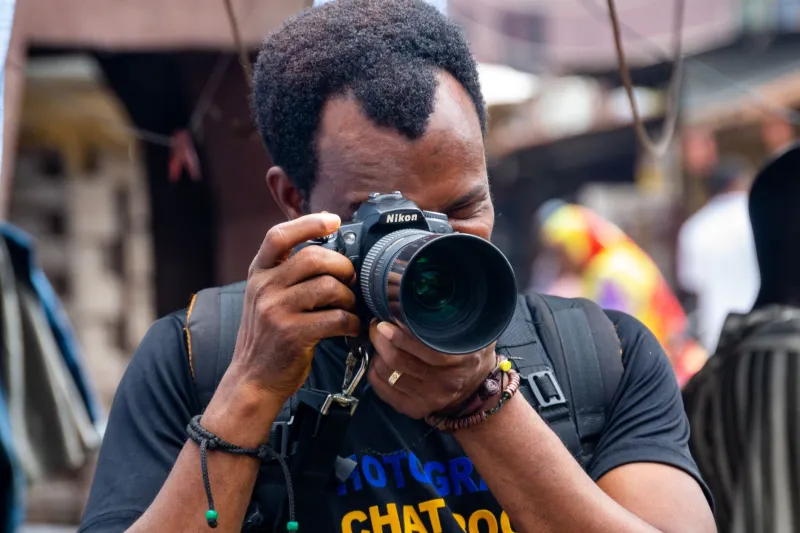
A 35mm or 50mm full-frame equivalent is perfect. On a crop sensor, look for a 23mm or 35mm. One lens forces you to move your feet, which is good for a neighborhood story because it puts you closer to people. The phone is not there to replace the camera. It is there for the wide establishing shot you cannot get, for notes, and for a backup if your card fills up.
Do not switch lenses every five minutes. Do not chimp after every frame. Stay in the scene.
Approaching people without the cringe
Have a short script. Mine is: 'Hi, I'm working on a photo story about this block. I love the light in here. Can I make a portrait for it? I'll send you a copy.' Then show them the back of the camera if they seem unsure. Respect the first no. Do not photograph kids without asking a parent. In the US, public-space photography is generally legal, but a portfolio story is also a relationship. Ask first when a face is the subject.
If someone says yes, get their name and email. Send the photo. That one follow-up turns a hit-and-run shooter into a neighbor.
Edit for consistency
A photo essay should feel like one voice, not twelve different presets. Pick a white balance, a contrast level, and a color treatment, then apply it across the set. In Lightroom Mobile, start with highlights -20, shadows +10, clarity +5, and saturation -5. Save that as a preset and sync it to the whole story. Then go back and adjust individual frames so nobody looks green and the night shots do not look like day.
Use the contact sheet view in Lightroom or Apple Photos. Small thumbnails expose weak frames fast.
Sequence the story
Open with place. Move to people. Add a little tension or contrast in the middle, maybe the busy market next to the quiet bus stop. End with a frame that feels like a closing chord. Caption with names, dates, and the block. Write alt text for every image if you publish online. It is good practice and it makes you look at the photo again.
Publish cheap and clean
You do not need a custom website. Adobe Portfolio is included with Creative Cloud, Carrd costs about the price of lunch, and Pixieset has a free tier that looks clean. WordPress.com works if you already have it. Keep the page simple: twelve images, a short intro, and captions. Do not bury the story under a slideshow.
Use Notion or a plain text file for caption drafts. Put the title, location, and date at the top. Then share the link with the people you photographed. That is the whole launch.
The neighborhood story does not need a grand adventure. It needs a block, a lens, and enough patience to go back on a Tuesday.